20110112

MANAGING CHANGE EFFECTIVELY WITH ERP: The impact on 5 key business functions

Learn & Lead >>> with this Report
managing-change-effectively-with-erp-the-impact-on-5-key-business-functions.pdf
View  

450k

Dr Damigos; PhD

Expanding the enterprise: Breaking the barriers to collaborative product development.

Learn & Lead >>> with this Report

expanding-the-enterprise-breaking-the-barriers-to-collaborative-product-development.pdf
View  
 
382k

Dr Damigos; PhD

Security & Fraud: The Latest Tactics and Potential Business Impact

Learn & Lead >>> with this Report

fraud-alert-the-latest-phishing-tactics-and-potential-business-impact.pdf
View  

20110107

O2 INSIDE BUSINESS MANAGEMENT

O2 INSIDE BUSINESS MANAGEMENT

>>> ACTIONABLE INSIGHTS
>>> KNOWLEDGE YOU CAN TRUST

Dr Damigos / O2ibm >>>Achieve More While Doing Less

Amplify’d from o2ibm.blogspot.com

Achieve More While Doing Less


Achieve More While Doing Less

By David R. Butcher
When confronted with a daunting quantity of work, it may help to concentrate less on time and more on efficiency. Some say working smart beats working more. Here are some ideas for working better, not harder.

Many of us are trying to do a lot more with much less: fewer resources and less time. A possible solution to this imbalance is to concentrate on effort and accomplishment and not on the amount of time spent.

"The more goals you're chasing, the harder it is to keep enough attention and energy focused on any one of them," the Dumb Little Man blog says. "Many of us could achieve much more by doing a bit less."

Dr Damigos >>>Successful Strategic Planning

Amplify’d from o2ibm.blogspot.com

Successful Strategic Planning


strategy and business

Successful Strategic Planning

In times of great uncertainty, strategic planning must shift from a bureaucratic, linear process to a more targeted approach that is both analytic and creative...

Making Change Happen, and Making It Stick

Amplify’d from o2ibm.blogspot.com

Making Change Happen, and Making It Stick


strategy and business

Making Change Happen, and Making It Stick

Five factors make the greatest difference in fostering the new behaviors needed for a transformation. All of them reflect the basic importance of people in implementing and embedding change.

 
Few organizations have escaped the need for major change in the past decade, as new technologies and global crises have reshaped entire industries. However, the fact that change has become more frequent does not make such changes any easier.

Change is, at its core, a people process, and people are creatures of habit, hardwired to resist adopting new mind-sets, practices, and behaviors. To achieve and sustain transformational change, companies must embed these mind-sets, practices, and behaviors at every level, and that is very hard to do — but it has never been more important.

Some organizations have managed to develop approaches to change management that address change comprehensively. A successful business transformation effort must capture the hearts and minds of people who need to operate differently to deliver the desired results. The good news is that it can be done...


KeyWords:
Change,
strategy


Posted by
O2ibm / DRibm Editorial Team - Dr. Damigos; PhD
Read more at o2ibm.blogspot.com
 

The Seven Deadly Sins of Measurement

Amplify’d from o2ibm.blogspot.com

The Seven Deadly Sins of Measurement

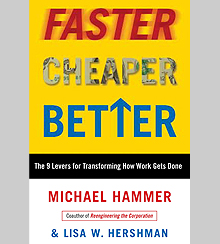
Jim Champy, coauthor, with Harry Greenspun, of Reengineering Health Care: A Manifesto for Radically Rethinking Health Care Delivery, introduces a lesson on the pitfalls of measurement from Faster, Cheaper, Better: The 9 Levers for Transforming How Work Gets Done, by Michael Hammer and Lisa W. Hershman.

The late Mike Hammer always delivered the unexpected in a strong voice with an intelligent edge that woke you up. When we coauthored Reengineering the Corporation, I discovered that no partner could have been more insightful, more probing into the behaviors of companies and their managers. Mike also had a great talent for metaphor. He said that inefficiencies were like fat marbled into a piece of meat, and that to get costs out you had to grind up the company and fry out the fat. That metaphor never made it into our first book. I told Mike that executives wouldn’t respond well to the notion of treating their companies so brutally.

But that didn’t stop Mike from being a radical thinker, always challenging the way things are done. He disdained the notion “if it ain’t broke, don’t fix it.” In this excerpt, from the book that Mike was working on before his untimely death at age 60 in 2008 (a work completed by his colleague Lisa W. Hershman), you will see that even things that look right can be wrong. Read it several times to grasp everything that’s here on how managers misuse metrics and measurement processes — sometimes unwittingly, sometimes purposely to deceive. It’s quintessential Hammer.

— Jim Champy


Excerpted from Chapter 2 of Faster, Cheaper, Better:

The 9 Levers for Transforming How Work Gets Done


In the sixth century Pope Gregory the Great formulated his famous list of the seven deadly sins — gluttony, greed, wrath, lust, sloth, envy, and pride. There are also seven sins of corporate measurement. Gregory’s list was meant to help an individual’s quest for salvation. Ours is more mundane: saving companies from fatal flaws in performance measurement...


Change

Amplify’d from o2ibm.blogspot.com

Making Change Happen, and Making It Stick


strategy and business

Making Change Happen, and Making It Stick

Five factors make the greatest difference in fostering the new behaviors needed for a transformation. All of them reflect the basic importance of people in implementing and embedding change.

Few organizations have escaped the need for major change in the past decade, as new technologies and global crises have reshaped entire industries. However, the fact that change has become more frequent does not make such changes any easier.

Change is, at its core, a people process, and people are creatures of habit, hardwired to resist adopting new mind-sets, practices, and behaviors. To achieve and sustain transformational change, companies must embed these mind-sets, practices, and behaviors at every level, and that is very hard to do — but it has never been more important.

Some organizations have managed to develop approaches to change management that address change comprehensively. A successful business transformation effort must capture the hearts and minds of people who need to operate differently to deliver the desired results. The good news is that it can be done...


Read more at o2ibm.blogspot.com

Growth through Focus: A Blueprint for Driving Profitable Expansion

strategy and business

Growth through Focus: A Blueprint for Driving Profitable Expansion

Rather than seek increased revenues and profits by expanding products and markets, companies should follow a seven-step strategy for achieving more with less.

Faced with economic headwinds, many global corporations are struggling to grow their businesses profitably. In the consumer packaged goods business, for example, the worldwide recession has hurt premium brands as consumers have traded down to cheaper brands, private labels, or generics. In the retailing business, same-store sales are flat or declining for numerous companies. Meanwhile, many business leaders continue to seek growth by extending their existing product lines and brands, as well as by entering new geographic regions. After all, growth is supposed to be about “more” — more products on the shelf, more categories, more brands, and more markets.
However, this approach is exactly the opposite of what business leaders should do to drive increased revenues and profits. A typical “growth through more” strategy diffuses the organization’s efforts. It increases the complexity of the organization and its operations. We have found that “growth through less,” or more precisely “growth through focus,” is the best prescription for growth, regardless of the economic environment. This conclusion is based on our own experience in three well-known companies — Kraft Foods, Unilever, and Fonterra Brands (a dairy products business based in New Zealand) — on three continents over 10 years. In all three cases, a deliberate strategy of focusing on a few markets, brands, and categories produced impressive revenue and profit expansion. We have learned that seemingly mature businesses can be energized by making fewer but larger bets and by focusing relentlessly on executing a simple but powerful vision.
Growth through focus is not as easy as choosing what strategic bets to make. Rather, it requires the leadership team to follow a systematic approach that spans everything from strategy and vision to execution and measurement. We propose a framework that consists of seven steps that an organization must go through in its quest for growth through focus. Our framework is grounded in three key ideas: focus in strategy, simplicity in communication, and empowerment in execution.........


Building Support for Change

strategy and business

Building Support for Change

A successful change management initiative requires commitment from all the organization’s leaders, not just the CEO.


To study the effect of leadership on organizational change, the authors explored the results of a change management initiative at Kaiser Permanente, a California-based HMO with more than 1 million members, 3,000 physicians, and 19 medical centers. Historically, Kaiser Permanente’s business plan had been predicated on its expansive relationships with a huge number of patients and providers, which enabled the company to offer competitive healthcare at reduced costs. But by 2001, management found that patients generally viewed Kaiser Permanente as bureaucratic and impersonal. Under a new CEO in 2002, the company attempted a significant shift, refocusing on quality and service. This meant introducing a new scheduling system, revamping call centers to improve responsiveness throughout the organization, and improving communication links between physicians and patients. After tracking the results of the initiative over two years (2001–03) in real time, the researchers concluded that efficient, thorough organizational changes resulted not because of the technology or procedures being introduced, but because of the commitment of Kaiser Permanente’s leaders — and not just those at the very top level.
The researchers used data from detailed satisfaction surveys of 50,000 patients and more than 300 physicians to gauge the success of the new plan. The study followed physicians in eight departments — including emergency medicine and pediatrics — at six Kaiser Permanente medical centers. At Kaiser Permanente, physicians report to a department chief (also an M.D.), whose immediate boss is the physician-in-charge (PIC), the executive responsible for the overall operations of the individual medical center. Kaiser Permanente’s CEO oversees all the PICs. The physician surveys explored how well the supervisors at all three leadership levels articulated a vision, set measurable goals, rewarded progress, dealt with organizational hurdles, and motivated employees. The research found that the more physicians perceived their department chief and PIC to be competent managers in all aspects of their job, the more they supported the strategy shift; in addition, patient access and service ratings improved most when physicians viewed both the CEO and PIC as effective leaders. However, when physicians felt that their bosses were less than adept, their performance on patient satisfaction surveys was markedly lower. Although the CEO imparted the same call for transformation in responding to patients throughout the organization, physicians who lacked respect for their managers tended to interpret this change agenda more negatively. Overall, patient ratings improved over the two-year study period.
It has long been assumed that CEOs drive organizational change, and that success or failure hinges on how well a single leader can articulate his or her vision. But this paper finds that organizations are much more nuanced, and leaders at many different levels can have a significant impact on whether their departments embrace or shun new initiatives. The authors advise CEOs to spend time making sure their leaders throughout the organization are fully informed, committed, and effective before undertaking a major change initiative.
Bottom Line: Organizational change is much more effective when leaders at all levels of a company are united behind the shift in strategy. Although CEOs can articulate an overall vision, the success of a new initiative often depends on the competence of managers at lower leadership levels.

Author Profile:

  • Matt Palmquist was a founding staff writer and is currently a contributing editor at Miller-McCune magazine. Formerly, he was an award-winning feature writer for the San Francisco–based SF Weekly.
For More See>>

Title: How Leadership Matters: The Effects of Leaders’ Alignment on Strategy Implementation
Author: Charles A. O’Reilly (Stanford University) et al.
Publisher: The Leadership Quarterly, vol. 21, no. 1
Date Published: February 2010

    Global Innovation 1000: How the Top Innovators Keep Winning

    strategy and business

    The Global Innovation 1000: How the Top Innovators Keep Winning

    Booz & Company’s annual study of the world’s biggest R&D spenders shows why highly innovative companies are able to consistently outperform. Their secret? They’re good at the right things, not at everything.

    Why are some companies able to consistently conceive of, create, and bring to market innovative and profitable new products and services while so many others struggle? It isn’t the amount of money they spend on research and development. After all, our annual Global Innovation 1000 study has shown time and again that there is no statistically significant relationship between financial performance and innovation spending, in terms of either total R&D dollars or R&D as a percentage of revenues.
    What matters instead is the particular combination of talent, knowledge, team structures, tools, and processes — the capabilities — that successful companies put together to enable their innovation efforts, and thus create products and services they can successfully take to market. This year’s edition of the Global Innovation 1000, our sixth, analyzes the capabilities systems that the most successful innovators have assembled to execute their distinct innovation strategies, and the ways they have aligned those capabilities with their overall business strategies. Innovators that have achieved this state of coherence, we have found, consistently and significantly outperform their rivals on several financial measures.
    We believe that this assessment of key innovation capabilities comes at a particularly opportune time. This year, for the first time in the more than a decade we have been tracking global R&D spending, total corporate R&D spending among the Global Innovation 1000 declined, from US$521 billion in 2008 to $503 billion in 2009, or 3.5 percent. (See “Profiling the 2009 Global Innovation 1000,” below.) Clearly, the global recession, which had not yet taken its toll on the world of innovation in 2008, finally came home to roost last year. Yet that decline makes it even more imperative that companies spend their available R&D dollars wisely. Our goal this year is to examine the capabilities needed to maximize the impact of a company’s innovation efforts in good times and bad, and to highlight the benefits both of focusing on the short list of capabilities that generate differential advantage, and of clearly linking the specific decisions within innovation to the company’s overall capabilities system and strategy..........


    Billion-dollar Ideas: Finding Tomorrow’s Growth Engines Today

    strategy and business

    Billion-dollar Ideas: Finding Tomorrow’s Growth Engines Today

    To create growth in uncertain times, use this disciplined and market-focused methodology. It can help you discover and distill attractive new ideas and build a business case for implementing the best of them.

     
    After several years of survival mode for many companies, growth is back on the agenda. But the requirements for success have changed. In today’s conditions — uncertain recovery, limited capital, and many new competitors — companies must find new ways to grow.
    There’s no going back to the growth ideas that were bouncing around the organization before the global financial crisis. Executives need a robust framework to help them rapidly develop a long list of opportunities and then choose the very best ideas from it. The process must be comprehensive, efficient, rigorous, collaborative, and focused on “market-back” opportunities designed to meet customers’ needs. And it must be bold — the company must resist the temptation to do what has been done in the past.
    Booz & Company has created a methodology for this, based on five lenses used for evaluating growth strategies. The five lenses — share of wallet, new regulations, technology and applications, distinctive capabilities, and business models — represent discrete and complementary ways to find and judge unconventional and unseen ideas. This approach has already been used successfully by companies in many industries and geographies...


    A right to win: Undisputed competitive advantage.

    strategy and business

    The Right to Win

    Business strategy is at an evolutionary crossroads. It’s time to resolve the long-standing tension between the inherent identity of your organization and the fleeting nature of your competitive advantage.

    It’s 8 a.m. in the executive conference room of a large global packaged-foods manufacturer (a real company, its name withheld to preserve confidentiality). For the past two months, a team made up of 15 senior people has been exploring options for growth, winnowing them down to three basic strategies. Each is now summed up in a crisp 20-minute presentation.
    The first option focuses on innovation. The company would rapidly develop and launch many new types of snacks and foods, packaged in new and interesting ways, offering leading-edge nutrition and convenience.
    Under the second option, the company would get closer to its customers, producing the food people ask for. It could incorporate ideas gathered online into its offerings and provide busy working families with customizable, convenient, and well-balanced meals.
    The third option would involve transforming the dynamics of the relevant food sectors by competing more aggressively. The company would become a category leader by investing in new process technology, rightsizing operations to push costs down, and completing key acquisitions.
    After the screen goes blank, the CEO leans forward and asks a simple question: “Which strategy would give us the greatest right to win?” His tone, calm and direct, makes everyone sit up a little straighter. And they probably should, for this is the core question underlying every business strategy, although it isn’t always phrased that way.
    A right to win is the ability to engage in any competitive market with a better-than-even chance of success — not just in the short term, but consistently....


    The 7 Deadly Sins of Measurement

    The Seven Deadly Sins of Measurement

    Jim Champy, coauthor, with Harry Greenspun, of Reengineering Health Care: A Manifesto for Radically Rethinking Health Care Delivery, introduces a lesson on the pitfalls of measurement from Faster, Cheaper, Better: The 9 Levers for Transforming How Work Gets Done, by Michael Hammer and Lisa W. Hershman.

    The late Mike Hammer always delivered the unexpected in a strong voice with an intelligent edge that woke you up. When we coauthored Reengineering the Corporation, I discovered that no partner could have been more insightful, more probing into the behaviors of companies and their managers. Mike also had a great talent for metaphor. He said that inefficiencies were like fat marbled into a piece of meat, and that to get costs out you had to grind up the company and fry out the fat. That metaphor never made it into our first book. I told Mike that executives wouldn’t respond well to the notion of treating their companies so brutally.
    But that didn’t stop Mike from being a radical thinker, always challenging the way things are done. He disdained the notion “if it ain’t broke, don’t fix it.” In this excerpt, from the book that Mike was working on before his untimely death at age 60 in 2008 (a work completed by his colleague Lisa W. Hershman), you will see that even things that look right can be wrong. Read it several times to grasp everything that’s here on how managers misuse metrics and measurement processes — sometimes unwittingly, sometimes purposely to deceive. It’s quintessential Hammer.
    — Jim Champy


    Excerpted from Chapter 2 of Faster, Cheaper, Better:
    The 9 Levers for Transforming How Work Gets Done


    In the sixth century Pope Gregory the Great formulated his famous list of the seven deadly sins — gluttony, greed, wrath, lust, sloth, envy, and pride. There are also seven sins of corporate measurement. Gregory’s list was meant to help an individual’s quest for salvation. Ours is more mundane: saving companies from fatal flaws in performance measurement...


    Making Change Happen, and Making It Stick

    strategy and business

    Making Change Happen, and Making It Stick

    Five factors make the greatest difference in fostering the new behaviors needed for a transformation. All of them reflect the basic importance of people in implementing and embedding change.

     
    Few organizations have escaped the need for major change in the past decade, as new technologies and global crises have reshaped entire industries. However, the fact that change has become more frequent does not make such changes any easier.
    Change is, at its core, a people process, and people are creatures of habit, hardwired to resist adopting new mind-sets, practices, and behaviors. To achieve and sustain transformational change, companies must embed these mind-sets, practices, and behaviors at every level, and that is very hard to do — but it has never been more important.
    Some organizations have managed to develop approaches to change management that address change comprehensively. A successful business transformation effort must capture the hearts and minds of people who need to operate differently to deliver the desired results. The good news is that it can be done...


    Successful Strategic Planning

    strategy and business

    Successful Strategic Planning

    In times of great uncertainty, strategic planning must shift from a bureaucratic, linear process to a more targeted approach that is both analytic and creative.

    Strong strategic planning is critical to the success of every organization. It is the process by which strategy is translated into concrete short-term actions. It can also be a vehicle for deciding which markets are important to your company’s future, and which capabilities you will need to reach those markets effectively.
    Over the years, the exercise of strategic planning has created strong advocates and fierce critics in equal measure. The recent financial crisis has renewed many people’s skepticism about strategic planning — as unimaginably bleak scenarios forced businesses to rapidly recast their most fundamental business assumptions and recalibrate their priorities. But there is no reason to be skeptical if you orient your strategic planning process to the unique needs of your company. Together, the following five pillars of corporate strategic planning ensure that your processes are up to the challenges of today’s dynamic business environment...

    20110106

    Achieve More While Doing Less

    Achieve More While Doing Less

    By David R. Butcher
     
    When confronted with a daunting quantity of work, it may help to concentrate less on time and more on efficiency. Some say working smart beats working more. Here are some ideas for working better, not harder.
    Many of us are trying to do a lot more with much less: fewer resources and less time. A possible solution to this imbalance is to concentrate on effort and accomplishment and not on the amount of time spent.
    "The more goals you're chasing, the harder it is to keep enough attention and energy focused on any one of them," the Dumb Little Man blog says. "Many of us could achieve much more by doing a bit less."
    Here are some ideas for doing just that:


    Top Business Management Reading 2010

    Best of Recommended Reading 2010

    By Ilya Leybovich
    The following 10 books were the most popular Recommended Reading choices in 2010. From business know-how to historical analysis, these books will keep you entertained and informed in 2011.
    book10.9a.JPG
    Poorly Made in China: An Insider's Account of the Tactics Behind China's Production Game
    Poorly Made in China is a dramatic and often witty travelogue of one man's journey through China's export manufacturing sector. Author Paul Midler reveals what really goes on behind the scenes of the Asian giant's export industries. The story follows the author from one project to the next, capturing why so many quality failures could come out of China at once and exploring what the consequences of the country's rapid economic rise mean for the world.
    Hardcover, 256pp
    Wiley, John & Sons, Inc., April 2009
    Barnes & Noble online price: $16.63


    IMT10.21PowerfulIdeaCover.JPG
    The Most Powerful Idea in the World: A Story of Steam, Industry, and Invention
    In tracing the development of the steam engine through a close examination of the creative processes of pioneering inventors, award-winning author William Rosen's The Most Powerful Idea in the World sheds light on how tremendous innovations come into being. Along the way, Rosen introduces readers to a huge cast of colorful historical figures and illustrates how the world sprang into a sustained period of rapid growth and development within a single generation.
    Hardcover, 400pp
    Random House Publishing Group, June 2010
    B&N online price: $18.67


    AwesomelySimpleCover.JPG
    Awesomely Simple: Essential Business Strategies for Turning Ideas into Action
    Running a business in today's world can mean dealing with all sorts of distractions, but in Awesomely Simple, author John Spence provides practical strategies for cutting through the day-to-day clutter of operating a company. Using case studies, easy-to-follow guidelines and tips for improving efficiency, this book shows how a streamlined approach to business may be better than an unnecessarily complex alternative.
    Hardcover, 208pp
    Wiley, John & Sons, Inc., September 2009
    B&N online price: $15.83


    The4HourWorkweekCover.JPG

    The 4-Hour Workweek, Expanded and Updated: Escape 9-5, Live Anywhere, and Join the New Rich
    Ever wished you could start living more and working less? Serial entrepreneur and "ultravagabond" Timothy Ferriss offers his strategies for escaping the rat race but without sacrificing your income. His bestselling, step-by-step guide shows you how to build a career on short work bursts, take mini-retirements, get rid of unnecessary work and find ways to make more money. The expanded version features over a hundred pages of new material. Hardcover, 396pp
    Crown Publishing Group, December 2009
    B&N online price: $11.58


    CrucialConversationsCover.JPG

    Crucial Conversations: Tools for Talking When Stakes are High
    Communication is paramount in business, which means that staying calm and collected during important interactions can be the key to success. In Crucial Conversations, a team of corporate consultants breaks down the methods for handling conversations with expertise and finding ways to achieve the results you want. Learn how to persuade others through talk and how to keep your conversational cool in high-pressure situations. Paperback, 256pp
    The McGraw-Hill Cos., June 2002
    B&N online price: $10.19


    book10.8a.JPG
    Switch: How to Change Things When Change Is Hard
    Learning to adapt can be difficult, even when it's the smartest possible option. In Switch, authors Chip and Dan Heath examine why people are reluctant to accept beneficial or necessary changes. Drawing on research in psychology, sociology and other fields, the Heaths show how everyday people (including managers and employees) can be motivated to accept new ideas.
    Hardcover, 320pp
    Broadway Books, February 2010
    B&N online price: $14.22


    book10.6a.JPG
    Getting to Plan B: Breaking Through to a Better Business Model

    Starting a new business can be fraught with uncertainty, even with a solid business plan. In Getting to Plan B, authors John Mullins and Randy Komisar explain that having a plan that changes as new challenges arise is the key to keeping a new business functional. They provide a rigorous "stress test" to see if your initial plan can keep up with your company's needs and determine whether you need a path to plan B.
    Hardcover, 272pp
    Harvard Business Press, September 2009
    B&N online price: $19.97


    book8.23a.JPG
    Mass Career Customization: Aligning the Workplace with Today's Nontraditional Workforce
    Offering a personalized experience to your customers is a great way to improve business, but employees may need a similar level of engagement if a company is to maintain its competitive advantage. In Mass Career Customization, Deloitte talent strategists Cathy Benko and Anne C. Weisberg explain how keeping employees engaged and connected will be increasingly important as the workforce shrinks, and they explore the four key factors in customizing a career.
    Digital eBook
    Harvard Business School Press
    B&N online price: $10.78


    TopGradingCover.jpg

    Topgrading: How Leading Companies Win by Hiring, Coaching and Keeping the Best People
    A company's success isn't only based on its business strategies — it also depends on its people. In a revised and updated version of the 1999 classic Topgrading, author Bradford D. Smart offers a practical approach to finding and managing the top talent. Drawing on case studies and interviews, the book provides helpful advice on how to harness a business's most valuable resources: its workers. Hardcover, 592pp
    Penguin Group, April 2005
    B&N online price: $19.97


    IMT10.22LinchpinCoverV1.JPG
    Linchpin: Are You Indispensable?
    There are some people who are simply indispensable to an organization. In Linchpin, business expert and bestselling author Seth Godin explains how these essential people innovate, connect divergent parts of the company and lead others — regardless of their position. Godin also illustrates how you can become indispensable by overcoming the resistance that holds people back.
    Hardcover, 244pp
    Penguin Group, January 2010
    B&N online price: $16.77

    Top Trade Shows for 2011

    25 Trade Shows to Visit this Year

    By Beth Goodbaum
     
    Discover the latest developments in your industry or market; mingle with experts; and see first-hand what your peers are doing. There are plenty of industry trade shows to visit this year. Here's a sampling of 25 to consider.


    Related Posts with Thumbnails